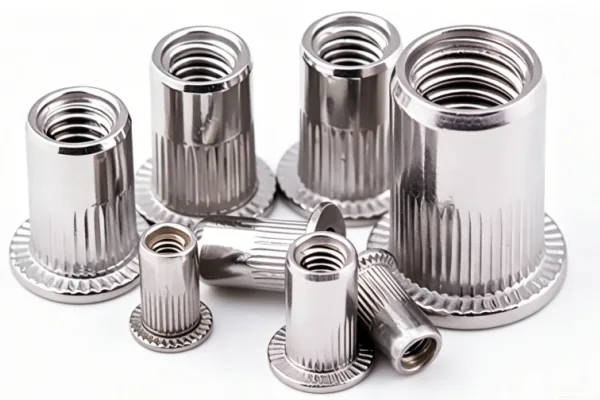

Blind rivet
blind rivet: scope, key limits and equivalent standards — the page engineers land on from a standard number.
Dimensions and tolerances
blind rivet gives scope, key limits and test acceptance, linking to our matching product families; differences between equivalent standards are flagged in the comparison table.
Material and property class
Material and finish for Blind rivet follow the duty: zinc-plated carbon steel covers most indoor structural joints; zinc-nickel for salt-spray beyond 720 h; 304/316 stainless for food, medical and outdoor; aluminium parts pair best with aluminium or insulated fasteners to avoid galvanic attack. State material, property class and coating together so price and lead time can be fixed.
Equivalent standards cross-reference
Blind rivet maps to several systems: GB/T, ISO, DIN and JIS differ slightly in head geometry, thread and property class. The table compares dimension, class and marking item by item; substitution is judged on critical dimensions and property class, not on swapping standard numbers.
Substitution and differences
Blind rivet is laid out here as parameters → judgement → action: usable data first, then the basis for the call, then concrete sizes and lead time. Table data is quotable as-is.
FAQ
What is the MOQ for Blind rivet?
What is the lead time for Blind rivet?
Can blind rivet be made to drawing?
Are inspection reports available?
Need a spec check or 1-day sample?
Send us your drawing, spec or part code. We reply the same day on stock, MOQ, tiered pricing and lead time (1-day sampling for stock; volume 7–15 days).
Call directly: +86 135-1036-9429(Mr. Zhang (Engineering & Sales Director)) · +86 135-6073-0094(Ms. Fan (Sales Manager))